Toolbar#
The toolbar provides quick access to the most frequently used functions and test interactions.
| Icon | Description |
|---|---|
 |
Create a new project (see new project) |
 |
Open a project (see open project) |
 |
Save the current project (see save project) |
 |
Run all tests, previous measurement data will be overwritten (Shortcut: F5) |
 |
Run all tests and append data (Shortcut: F6) |
 |
Run a selected single test, previous measurement data will be overwritten (Shortcut: F7) |
 |
Run a selected single test and append the data (Shortcut: F8) |
 |
Stop the test execution |
 |
Skip the current running test |
 |
Pause the test execution |
 |
Continue the paused test execution |
 |
Edit the project settings (see project settings) |
 |
Edit the measurement information (see measurement info) |
 |
Open the Device manager (see device manager) |
 |
Open the Switching configuration (see switching configuration) |
 |
Open the Data Viewer (see data overview) |
 |
Open the Statistic Viewer (see statistic view) |
| Open the Package manager (see package manager) | |
 |
Open the User manager to administrate all user accounts. This function is only available when user management is enabled |
 |
Open the dialog to switch to another user account and/or level. This function is only available when user management is enabled |
Table: Toolbar
Measurement Information#
The measurement info is the overview of all general information to make a test identifiable. All of the information will be stored in the measurement data file in a separate node. By default, the following indicators can be set individually by the user: Operator, WorkPlace, Lot, SubLot, BarCode, Batch, Wafer, DUT, Comment, Info1-3, GoldenDevice, Technology, Tester, Temperature, Environment. The available items, their default values and their protection are defined in the program settings. If activated in the project settings, the dialog will pop up before the test starts and allows the operator to link the user-specific data to a measurement.
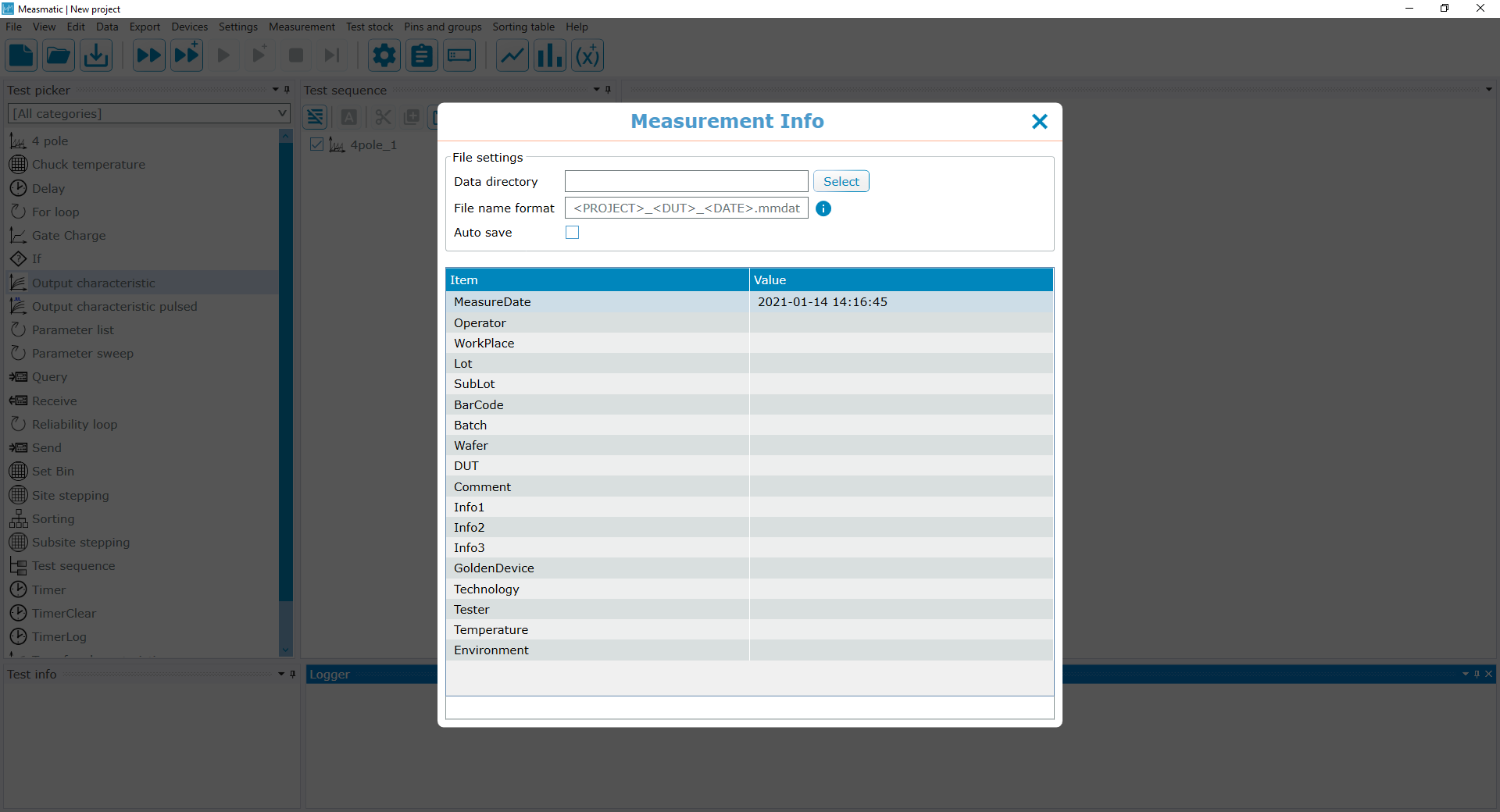
Measurement Info
| Function | Description |
|---|---|
| Data directory | Directory where the measurement data will be stored |
| File name format | User-defined file name format for the measurement data file. Available placeholders are listed in the information menu beside the textbox |
| Auto save | If enabled, the data will be saved automatically after a test sequence run (see project settings) |
Table: Measurement Info
Data Overview#
The Data Viewer displays measurement data of several tests of the project in a common chart. In the "Curve Definitions" table, a curve is added with the plus button; for each curve the test and the parameters for the X, Y1 and Y2 axis are selected. Optionally the reference curve and the error band can be shown. The rendered curves are listed on the right side and can be enabled or disabled individually. In the chart, dragging zooms, middle-click pans and right-click saves the chart as an image. The tab "Value table" shows the values of the curves as a table.
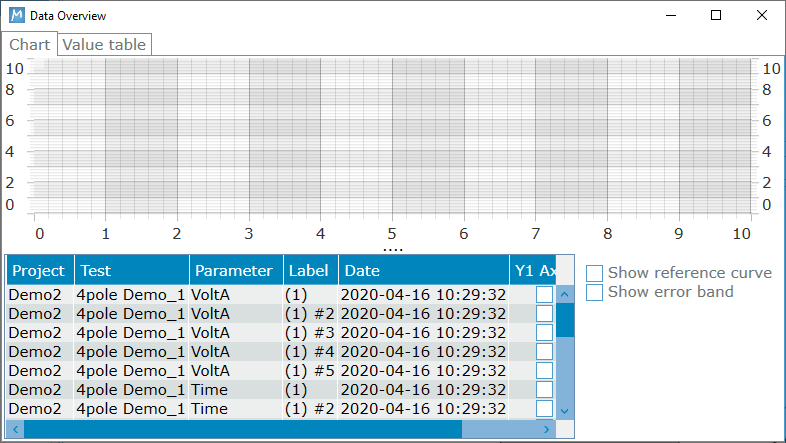
Data Overview
Statistic View#
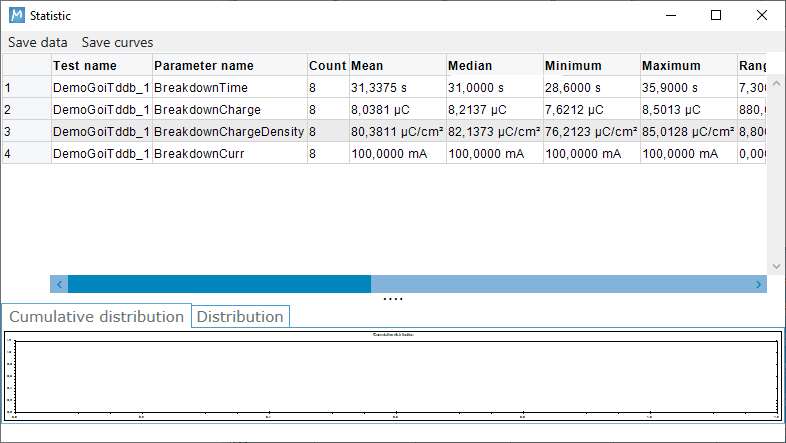
The statistic view allows the user to compare the measurement values and check the statistical distribution to evaluate the test repeatability.
The table "Measurement Statistics" lists the statistical values of the output parameters. Selecting one or more rows (hold Shift or Ctrl) shows the distribution charts of the selected parameters. The option "Show KDE curves" adds Gaussian kernel density and cumulative distribution curves to the charts.
| Function | Description |
|---|---|
| Export Data | Saves the raw or formatted statistic as CSV or Excel file |
| Export Charts | Saves the distribution or the cumulative distribution of the selected rows as CSV or Excel file |
Table: Statistic view
Each distribution chart can be saved as PNG image via its context menu.
Statistic